Students across the University of Mary Washington capped off their fall semester with an unexpected snow day that only added to the excitement of presenting original research and creative work developed over months of effort.
Across a series of end-of-semester symposia—held in multiple academic departments and slightly reshuffled due to the weather—students shared the outcomes of that work. Posters, video screenings, presentations and discussions offered a window into the range of questions students pursued and the methods they used to explore them. Projects spanned the sciences, humanities, arts and social sciences, illustrating the breadth of research and creativity that defines UMW’s undergraduate experience.
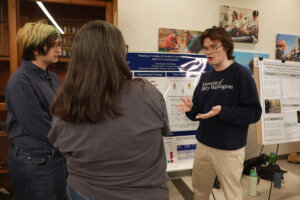
At the Jepson Science Center Fall Research Symposium, more than 70 projects were showcased. Undergraduate researchers in biology, chemistry, physics, earth and environmental sciences filled the lobby and main floor with posters detailing experiments, fieldwork and laboratory analysis. The projects reflected a wide range of scientific inquiry—from immune signaling and neurodegeneration to watershed ecology and climate reconstruction.
Senior William Burkey, an applied physics and biological sciences double major, investigated how microplastics alter the mechanical properties of biological tissues, pulling together both his majors. “Seeing how physics principles can help explain changes in living tissue gave me a new way to think about the biological problems I want to study when I go into veterinary science in the future,” he said.
Senior biomedical sciences major, Sabrina Perez, presented her work examining whether prolonged exposure to the protein C3 keeps microglia in a heightened inflammatory state, with implications for Alzheimer’s disease and other neurodegenerative conditions. “My results have been mixed so far, which is frustrating but also part of real research,” said Perez, who plans to enter the medical field after graduation. “I’m going to keep working on the project next semester to see whether clearer patterns begin to emerge.”


Other student teams analyzed coral geochemistry to reconstruct long-term climate patterns, quantified the force exerted by milkweed beetle mandibles during combat, modeled projectile motion with drag and examined how local fish, mussel and stream communities respond to shifting environmental conditions.
Student interns working with University Communications shared fall video projects that explored topics such as the reunion of former roommates, behind-the-scenes moments with UMW baseball, the architectural history of campus buildings and highlights from Fredericksburg’s downtown neighbors. Each intern presented two episodes of a four-part series and took questions from the audience.
Blake Bauer, a senior majoring in historic preservation and museum studies, reflected on what surprised him most about his project. “Even though the episodes only last a minute or two, the editing process takes much longer than I imagined,” he said. “But it’s the small details that took extra time that made the final product so much better.”
At the Honors Senior Capstone Fall Symposium, students delivered presentations offering in-depth examinations of their research, analysis and findings, followed by questions from the audience. Students in history, American studies and sociology presented their work online, showcasing sustained, independent inquiry on a range of topics. Across all events, students cited mentorship, hands-on learning and the opportunity to contribute to their fields as central parts of the experience.
“These end-of-semester symposia display what students can do when they take ownership of research and creative inquiry,” said Director of Undergraduate Research Elizabeth Lewis. “The work reflects not only technical skill but curiosity, persistence and a willingness to ask a lot of questions.”


