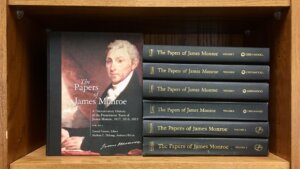
A $3 million grant from the National Endowment for the Humanities (NEH) will accelerate the completion of The Papers of James Monroe.
The funding will allow the 10-volume series, an expansive resource on America’s fifth president, to be completed early – in 2031, rather than 2035 as previously slated – in time to commemorate the 200th anniversary of Monroe’s death.
The five-year grant was awarded under the NEH’s Scholarly Editions in American History: Chairman’s Special Initiative program. It will fund personnel and other expenses related to the completion of the final three volumes of The Papers of James Monroe project, administered by the University of Mary Washington’s James Monroe Museum and Memorial Library in historic Fredericksburg.
“This transformative grant is a testament to the excellent work done by staff of The Papers of James Monroe over more than three decades,” said University Museums Executive Director Scott Harris. “We are grateful for the opportunity this presents to complete the project much sooner than would have been possible otherwise.”
Twice president of the United States, Monroe’s career in government and diplomacy spanned five decades. He served as a U.S. senator; spent three terms in the Virginia House of Delegates; was minister (ambassador) to France and Great Britain and envoy to France and Spain; was elected governor of Virginia four times; and held the offices of secretary of both state and war. Monroe also was an officer in the Continental Army, member of the Confederation Congress and delegate to the Virginia convention to ratify the U.S. Constitution.
Yet, much of what is known about him comes from scholarship on his political peers, including George Washington, Thomas Jefferson and James Madison.


“Viewed in the context of other people’s lives, Monroe has been mistaken as a character of secondary importance,” said Bob Karachuk, editor and project director of The Papers of James Monroe. The publication, he said, gives scholars easier and broader access to Monroe’s papers, “allowing them to assess Monroe in his own right and not as a mere adjunct to his contemporaries.”
About 600 documents – letters sent and received by Monroe, financial accounts and receipts, farm records, legal opinions, military orders, political writings and more – comprise each volume. They offer direct access to elusive original sources spread among more than 180 archives and libraries.
Monroe’s penmanship alone presents a challenge, Karachuk said. “When researchers can access Monroe manuscripts, they often struggle to read them. His handwriting — challenging at its best, mystifying at its worst — requires practice and patience to decipher.”
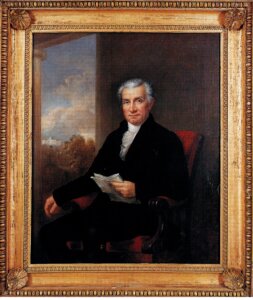
With the publication of the first volume of The Papers of James Monroe, he was belatedly added to the list of the nation’s founders treated in modern documentary editions in 2003. “That Monroe belongs there appears evident when one considers the many offices that he held and the important events in which he was a central figure,” said Karachuk, who completed a 68-page grant application.
With seven volumes already finished, the new funding will expedite the final three in the series. NEH has been the primary funder of the project since 2011, including an August 2023 grant of $345,000.
The eighth and ninth volumes will cover Monroe’s two presidential terms, from March 1817 to March 1825, and its landmark accomplishments, including the Monroe Doctrine. Volume 10 will explore the last half-dozen years of his life.
The complete series will serve as a boon to researchers, Karachuk said. “The Papers of James Monroe presents a broader, deeper and more representative documentation of the life and career of James Monroe than has been available until now.”
To learn more, visit the Papers of James Monroe website or stop by the James Monroe Museum at 908 Charles St. in historic Fredericksburg.