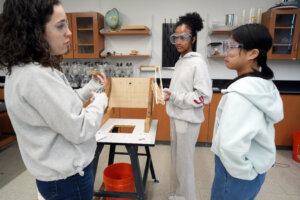
Eliora Teshome held her breath while her balsawood bridge was put to the test. The Lake Braddock Secondary School student from Burke, Virginia, had worked for months – in her school’s testing lab, during library hours and late at night – with fellow eighth-grader Rebecca Huang to build the miniature model into a winning weight-bearing structure.
“It’s a lot of fun testing it out and seeing it improve,” said Teshome, whose engineering-category entry claimed no construction-parameter violations but collapsed under the weight of added sand. “We have a lot more events coming up so we’re going to give ourselves some grace with this one.”
The middle-school team members were among hundreds of competitors from across the Commonwealth to converge on the University of Mary Washington this past weekend for a Virginia Science Olympiad (VASO) regional competition. A celebration of STEM (science, technology, engineering and math) learning, the tournament brought fifth- through 12th-graders together to battle it out in nearly 50 contests covering anatomy, meteorology, water quality and everything in between.
“This tour brings together the best schools in the state,” VASO State Director Emily Owens said of the event, with challenges fanning out on all four floors of the Jepson Science Center, as well as the Goolrick Fitness Center and Hurley Convergence Center. “It’s an amazing opportunity for our students to share their work, and the best part is it’s collaborative.”


Sixth-graders Elena Shahpar and Leon Kim from Spring Hill Elementary School in McLean used their forensics knowledge to look for the likeliest suspect in a crime-solving scenario that provided a series of clues. Using microscopes, beakers and test tubes, they sifted through provided evidence – including the shoe prints of alleged perpetrators – using methods like burn tests and chromatography to analyze fibers and substances. “I love to explore new topics,” Kim said of the process of preparing for Saturday’s competition. “I improved a lot in forensics.”


Jack Gab, an 11th-grader from Thomas Jefferson High School in Alexandria, answered test questions about rocks and minerals – how they were formed, what they say about the planet’s history and other fundamentals. “You get to touch and interact with actual samples,” he said. “It’s a fun way to show what we’ve been learning over the last few years.”
Contests also included chemistry, coding, electricity, genetics and more, plus the construction and performance of rubber-powered helicopters, self-propelled hovercraft and completely electric vehicles. In addition to showcasing STEM learning, VASO competitions encourage creative thinking, problem solving and team building, said UMW Senior Lecturer of Biology Michael Stebar, who helps coordinate the event on campus.


“The Olympiad is a great experience that nurtures students’ curiosity in science and math,” he said. “It helps them develop analytical and interpersonal skills, which will definitely help them succeed in school and life in general.”
He also noted that participants’ time at Mary Washington provides a glimpse of a college campus and what it’s like to work in a modern university laboratory.
“Working with the Science Olympiad is always inspirational,” Stebar said. “Seeing the students’ enthusiasm and determination reinvigorates my own interests in science and makes me optimistic for our future.”
Visit the Virginia Science Olympiad website to see the winners and complete results of this weekend’s competition.
This is a wonderful opportunity for students to learn, gain hands-on experience, and explore scientific experiments. The University of Mary Washington deserves tremendous recognition for creating a forum for the Science Olympiad. Programs like the Science Olympiad should be strengthened and expanded because they inspire students to explore the world of science and develop a deeper interest in scientific discovery.