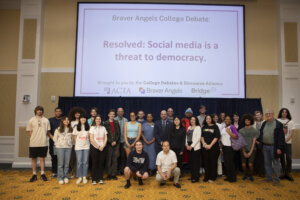
Zoe Rapp’s sentiments about social media were met with soft finger snaps of approval last week during a different kind of debate at the University of Mary Washington.
Part of a national movement to support civil discourse by embracing the power of dialogue, the “Braver Angels” debate format favors consensus over competition and fosters the understanding of different perspectives. Speakers share their viewpoints on a pre-chosen topic without fear of retaliation, while audience members ask questions through a facilitator to avoid personal attacks. And the crowd shows support with subtle movements like finger snaps, knee pats and toe taps.
Rapp, who’s in her first year, joined other students from UMW, along with some from Germanna Community College, to defend or disprove a central question: Does social media pose a threat to democracy? The public square-style debate was part of the VA250 celebration of America’s semiquincentennial, with government-recognizing events taking place across the Commonwealth. About 100 people attended the debate, held in the Chandler Ballroom inside Mary Washington’s Cedric Rucker University Center.
“I was happy to see how excited students were to discuss the issue and that they felt energized by the Braver Angels debate model,” UMW Center for Community Engagement Director Sarah Dewees said of the event, which was designed to reveal how recognizing different opinions can present opportunities for growth, empathy and collaboration.
Rapp’s position – that social media is as likely to help democracy as it is to harm it – was acknowledged by debate facilitator, American Council of Trustees and Alumni (ACTA) Curricular Fellow Bryan Paul, who asked to be addressed as the event’s “Honorable Chair.”


“I agree that it seems like social media is the new evil in this world,” Rapp said, “but social media cannot move without human action.” Posts and discussions on platforms like Facebook, Twitter and Instagram, she said, can also serve to spread new ideas, inform voting and strengthen democracy.
Her position was discussed by audience members with similar and conflicting views, who went through Paul to bring up questions about the contributing effects of topics like generative AI, algorithms created by humans and echo chambers that reverberate users’ expressed opinions.
Alina Jiang, a high school senior who’s also enrolled at Germanna, presented a different take on the topic. “Hidden behind a screen, many people were not afraid to do whatever it takes to get their point across,” she said. “When people have a mask to hide behind, a darker side to them can come out.”


Focused on understanding rather than division, Braver Angels debates encourage respectful dialogue even when it’s uncomfortable. They ask participants to arrive with open minds and hearts, listen as much as they speak, and challenge ideas without attacking. Students who take part in these types of exercises, organizers say, are more likely to hold respect for people with differing viewpoints and to share their opinions in class.
The Braver Angels debate was also supported by ACTA’s College Debates and Discourse Alliance, the State Council of Higher Education for Virginia (SCHEV) and Bridge USA, which promotes political dialogue on college campuses. Additional participants included Mary Washington’s Student Government Association, Bridge UMW, UMW Votes and Farmer Fellows.
“If we can’t talk about the pressing issues, how can we hope to have self-government,” Paul said. “Hopefully tonight is just a starting point for us to continue these conversations.”
Leave a Reply