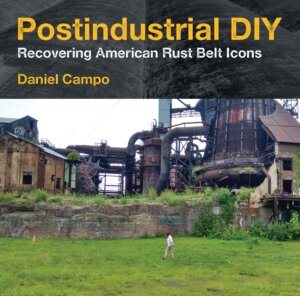
 A lecture by the winner of the University of Mary Washington’s 2025 Center for Historic Preservation Book Prize will be presented on Tuesday, Nov. 11, at 5:30 p.m., in Combs Hall, Room 139. Daniel Campo will speak about his book, Postindustrial DIY: Recovering American Rust Belt Icons.
Once bustling with more manufacturing jobs than anywhere else in the country, the Northeastern Great Lakes region hit its peak in the late 1940s. As the economy changed, cities like Chicago, Detroit and Pittsburgh closed factories, and the American Rust Belt began to take hold.
Now, as the area dusts off the rust, communities have begun to see beauty in the abandoned and reward in restoring once-meaningful structures. It’s a bottom-up renovation phenomenon that’s catching hold across the globe. Campo’s book digs into grassroots urbanism, as sites – iron mills, train stations, grain elevators – are renovated.
“The work calls attention to the power individuals have in shaping their environments … while the DIY era may be shifting, it is not yet over,” said jurors, who deemed it an exciting and empowering approach to historic preservation. “The book serves as a valuable roadmap for those interested in preserving sites that have historically been seen as liabilities – factories, silos, furnaces – and the innovative strategies that can drive change.”
An urbanist who teaches in the Department of Graduate Built Environment Studies at Baltimore’s Morgan State University, Campo spent years collecting case studies that reveal the nuances of the Rust Belt revival and the citizen preservationists whose interests stretch beyond profitability.
Published by Fordham University Press in February 2024, his Postindustrial DIY sheds light on a movement taking place across the country and around the world. While the author concentrates on grassroots urbanism near the Great Lakes, similar revitalization efforts are occurring everywhere from Kansas City to São Paulo, Brazil, where local groups are finding creative ways to improve their urban environments.
Campo’s composition “celebrates the love communities have for their spaces, capturing moments that transcend the buildings and structures themselves …,” said the jury who chose it to win. “Postindustrial DIY is filled with dynamic conversations, making a compelling case for engagement beyond academia. Its focus on blue-collar communities and their role in claiming spaces of labor is especially poignant, giving credit to those who choose to care for and protect their environment.”
The Historic Preservation Book Prize, established in 1988 and first awarded the following year, is announced each spring. The winner – who receives $500 and is invited to present at UMW – is selected by a jury of preservation academics and professionals who choose the book with the most potential for positively impacting the discipline of historic preservation in the United States. Specifically, the group focuses on books that break new ground or contribute to the intellectual vitality of the preservation movement.