When Sean O’Brien ’09 graduated from the University of Mary Washington, smartphones were the latest technology tools on the market. Within six years, almost everyone had one of these handy devices in their palm or pocket.

Yet, it only took two months for ChatGPT to top 100 million users, he added, illustrating the acceleration of artificial intelligence, or AI. “Humanity has always lived through technological revolutions,” O’Brien said, citing the printing press, telephone and internet. “But when a tech storm arrives, the question is, how do we navigate it?”
That’s what O’Brien – an associate vice president at Internet2, a national tech consortium for higher education – discussed when he returned to campus last month to speak about the potentials and pitfalls of artificial intelligence. As UMW’s inaugural AI Expert-in-Residence, he’s providing students, faculty, staff and community members his critical insight on these tools and their tremendous impact on individuals, institutions and society.
His talk, sponsored by UMW’s Center for AI and the Liberal Arts, tackled these topics and more, creating a roadmap for how leadership, especially in higher education, should prepare for these rapid changes.
The Center, led by Professor of Communication and Digital Studies Anand Rao, was launched last fall and serves as a hub for research, teaching and public engagement, bolstered by $100,000 gift in seed funding from UMW Foundation Board of Trustees member Donna Sheehan Gladis ’68 and husband Steve.
“Sean is a sterling example of how UMW liberal arts grads become leaders, especially in the AI era, when data is ubiquitous but empathy and judgment remain so important,” said Steve Gladis, who attended O’Brien’s talk. “Donna and I are so excited for the Center for AI, especially with Anand at the helm.”
O’Brien earned a bachelor’s degree in political science at Mary Washington, where he was Student Government Association president. He then worked in IT on campus before pursuing a master’s degree in communication and leadership studies at Gonzaga University.
“The liberal arts foundation I received [at UMW] shaped how I think about technology’s role in society,” said O’Brien, who is also mentoring students and advising faculty research this spring. “I’m excited to help current students develop the same thoughtful approach to AI.”
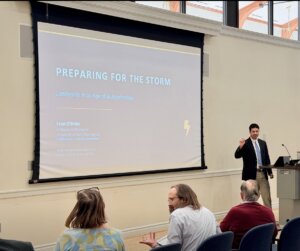
During his discussion, O’Brien delved into AI’s drawbacks and its impact on the workforce and the environment – but also its potential for breakthroughs in medicine, science and efficiency. Most current users employ consumer tools like ChatGPT and Claude for delegating simple tasks like writing a job description or summarizing a long document, he said.
“But the ability to produce, solve a problem, think through an issue, create something new – that’s where AI can become truly transformational,” said O’Brien, touting multimodal capabilities that allow a person to use these tools while walking the dog or relaxing on a beach.
However, he cautioned that while AI increases productivity, studies have shown that constant interaction with it can cause burnout, an effect known as the “energy vampire.”
He noted that the uniquely human skills often associated with the liberal arts – communication, relationship-building, critical thinking and empathy – will become more valuable and marketable to employers. “I don’t think AI limits the human experience,” he said. “It amplifies it.”
Colleges and universities should continue to teach students how to interrogate information and engage in ethical inquiry while still encouraging experimentation, he said. As these institutions adopt AI tools, he recommended they make thoughtful decisions before heavily investing in one product over another.
“Innovation isn’t a product you buy; it’s a behavior you practice,” he said. Praising Domain of One’s Own and UMW’s other projects that give students the chance to explore new technologies within the liberal arts, O’Brien added, “One of the things I genuinely admire about Mary Washington is that it has a history of putting this into practice.”
While he addressed concerns about the future of AI in society, he emphasized the importance of civic engagement. Citizens can push for increased regulations around privacy, more access for communities and protecting democratic institutions like a free press and universities.
“We all have a role in building the future we want it to be,” he said. “We can choose and act toward a vision that concentrates the power of this technology into the few, or one that democratizes it and allows for a new generation of builders.”
Watch Sean O’Brien’s full remarks as UMW’s AI Expert-in-Residence. Learn more about UMW’s Center for AI and the Liberal Arts.