Majors

Majors, Minors & Areas of Study

Studio Art

The world as you see it

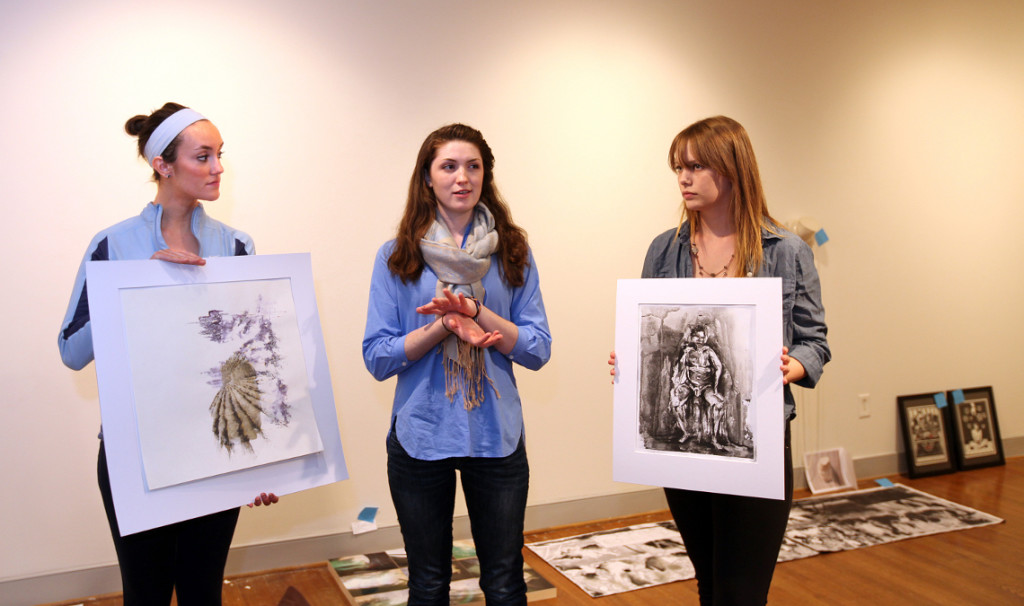
Art invokes insights, tells stories, records history, expresses emotions, illuminates our relationships and helps shape a complex world. Major in studio art at the University of Mary Washington and you’ll study contemporary issues and conceptual approaches to making art. All the while, you’ll expand your skills and your portfolio – in drawing, painting, sculpture, photography, ceramics, printmaking, digital media, and more.

Degree Awarded

Students majoring in studio art who complete all requirements earn the degree of Bachelor of Arts (B.A.) in studio art.

Areas of Study

UMW’s bachelor’s program in studio art will challenge you with courses in drawing, ceramics, sculpture, photography, painting, animation, digital media and other media. You’ll learn color theory, professional practices, and more.

Career Opportunities

With a bachelor’s degree in studio art from UMW, you’ll be prepared for such careers as graphic artist, illustrator, photographer, cartoonist, sketch artist, animator, designer, gallery owner, visual merchandiser, or art appraiser, among other possibilities.

Internships

A rich arts community in Fredericksburg and surrounding areas, including Richmond and Washington, D.C., offers many internship opportunities. UMW students have gained work experience at the UMW Galleries, LibertyTown Arts Workshop, Sophia Street Studios, the Visual Arts Center, and the Virginia Museum of Fine Arts, and at galleries and museums in Washington.

To qualify for honors in studio art, you must have a 3.5 grade-point average in the major and a 3.25 average overall. You’ll participate in all phases of a senior exhibition (including  planning and selecting work, installation, advertising, reception, and de-installation) and in a studio art faculty group critique.

The studio art major requires 42 credits, including 15 in required courses, 21 in medium-specific studio courses, and 6 in art history. Studio art majors are also required to participate in a major assessment before their senior year, and a senior assessment involving either an exhibition or an exit portfolio.

The Department of Art and Art history hosts a number of competitive scholarships in studio art. Studio art majors wishing to be considered for scholarships must demonstrate outstanding work in studio coursework. Recipients will file an artist statement and images with the scholarship coordinator.

Majors, Minors & Areas of Study

Religious Studies

Religions shape cultures.

They influence politics, create conflicts, and nurture unity. Major in religious studies at UMW, and you’ll study the traditions, texts and beliefs inherent in Buddhism Christianity, Hinduism, Islam, Judaism, and other religions to better understand how religious ideas and practices affect our lives. You’ll work on original research and a senior thesis as you hone skills in critical thinking, writing, and analysis.

Degree Awarded

Students majoring in religious studies who complete all requirements earn the degree of Bachelor of Arts (B.A.) in philosophy and religious studies.

Areas of Study

Study traditions, texts, and people to learn the historical and cultural impact of the world’s major religions. This program doesn’t ascribe to any particular belief system. Students work work one-on-one with faculty on research and a senior thesis and are encouraged to explore other disciplines – such as philosophy and anthropology – to help identify their special interests.

Career Opportunities

As a religious studies major, you will leave UMW with skills in critical thinking, persuasive writing, oral communication, and research. While some religious studies graduates pursue advanced degrees for careers in teaching and research, most develop careers in such diverse fields as public relations, journalism, business, teaching, service organizations, and the arts. The major is excellent preparation for studies in library science, law, social work, and the ministry.

Internships

Supervised off-campus internships are available to qualified students and are developed in consultation with religious studies faculty.

To receive honors in religious studies, you will need at least a 3.5 grade-point average in the major and a grade of A in the capstone course required of all religious studies majors. In that course, you’ll choose a topic for research, then write a 20- to 25-page thesis and present it to your fellow students.

The religious studies requires 30 credits in approved core and elective courses. All religious studies majors must complete a capstone course, in which they’ll write and present a thesis. Some classics or philosophy courses may count toward the major.

In addition to general scholarships awarded by the university, religious studies faculty award two scholarships specific to the religious studies major.

Majors, Minors & Areas of Study

Art History

See human history with an artist’s eye.

Even before humans developed writing systems, we expressed our ideas, observations, emotions and experiences through art. Major in art history at Mary Washington and you’ll access the rich resources of Washington, Richmond and New York while exploring the world’s artworks of antiquity to the modern day. You may spend a semester abroad to deepen your understanding as you prepare yourself for a life of empathy, observation, critical thinking and analysis.

Degree Awarded

Students majoring in Art History who complete all requirements earn the degree of Bachelor of Arts (B.A.) in Art History.

Areas of Study

Course offerings include History of Western Art, Egyptian and Near Eastern Art and Archaeology, History of Asian Art, Arts of Japan and Korea, Contemporary Asian Art, Greek Art, Roman Art, Art Museum Studies, Romanesque & Gothic Art, High Renaissance & Mannerism, Post-Impressionism to Abstract, American Art, and Pop Art to the Present.

Career Opportunities

With a background in the artistic masters and movements, UMW grads have created careers at such organizations as the American Association of Museums, Brooklyn Museum, Corcoran College of Art & Design, Delaware Art Museum, Hirschhorn Museum and Sculpture Garden, Metropolitan Museum of Art, National Gallery of Art, Smithsonian Institution, and Virginia Museum of Fine Arts.

Internships

Students gain valuable experience and career contacts through internships with UMW Galleries and prestigious museums and art institutions in Fredericksburg, Washington, D.C., and Richmond, Virginia.

To receive honors in art history, students must have a 3.25 grade-point average overall and a 3.5 GPA in the major, demonstrate excellence in upper-level courses in the major, and present an individual study research paper to the art history faculty.

The art history major requires 39 credits, including 12 credits from required courses; 15 credits from courses covering the major artistic eras from ancient through modern times; three seminar credits; and 9 art history elective credits.

Learn more about art scholarships at the University of Mary Washington.

Majors, Minors & Areas of Study

Geology

What lies beneath Earth’s surface?

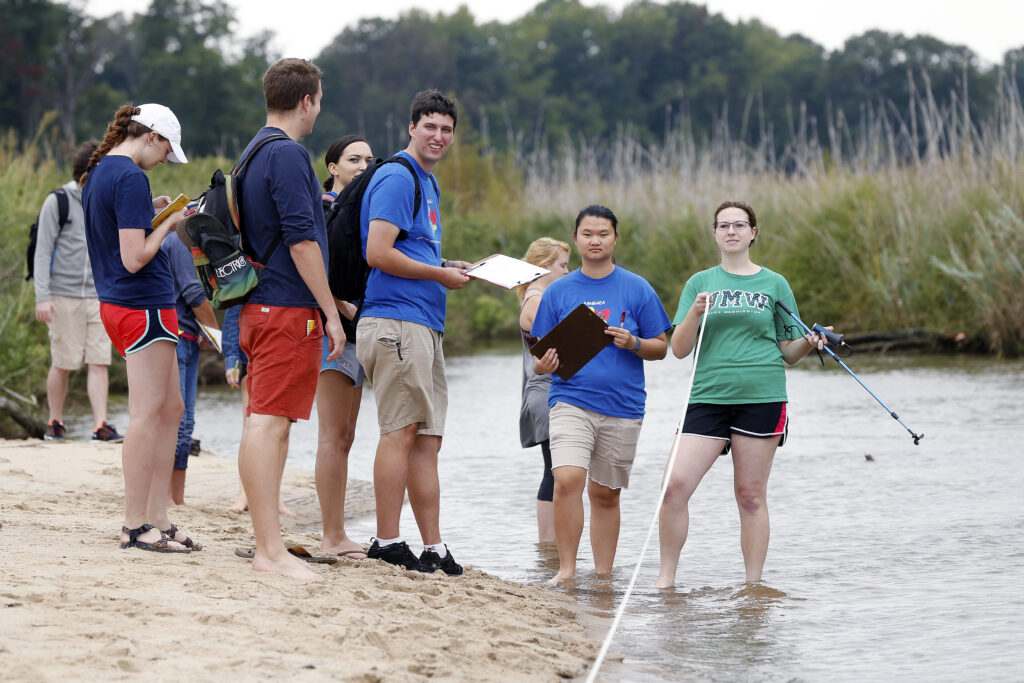
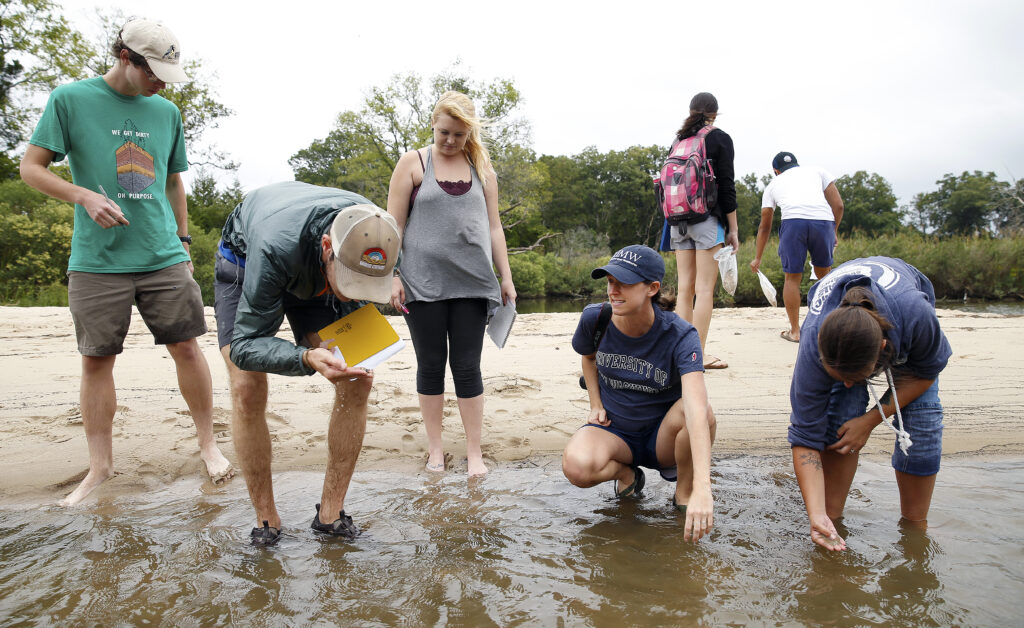
How do earthquakes, volcanic eruptions, climate change, and erosion shape our planet? Major in geology at the University of Mary Washington and you’ll study our world’s past with an eye on the future. UMW’s location near the Rappahannock River – between the Chesapeake Bay and the Shenandoah Valley – is a prime spot for fieldwork, and our proximity to D.C. and Richmond allows our majors to gain practical experience through internships. Explore courses that interest you most and conduct original research as you prepare to tackle tomorrow’s challenges. Our strong liberal arts program will help you develop the skills to begin your geology career or pursue an advanced degree.

Degree Awarded

Students majoring in Geology who complete all requirements earn the degree of Bachelor of Science (B.S.) in Environmental Science and Geology.

Areas of Study

Geology majors build on the principles of chemistry, physics, biology, and mathematics in their quest to understand our planet. Combine coursework in hard-rock geology, surficial processes, hydrogeology, oceanography, watershed management, soil science, climate change, energy resources and more with practical research and internships.

Career Opportunities

Job opportunities for geoscientists are increasing, with an expected growth between 2021 and 2031 of 15 percent. Possible career paths include industry, environmental consulting, teaching, government, or nonprofits.

Internships

In recent years, UMW geology and other environmental sciences majors have participated in internships with the City of Fredericksburg, the Army Corps of Engineers, the Virginia Department of Game and Inland Fisheries, Friends of the Rappahannock, Marstel-Day LLC, the Chesapeake Climate Action Network, Greenpeace, the U.S. Environmental Protection Agency, the U.S. Department of Agriculture, and more.

Students with a 3.0 overall grade-point average and a 3.25 average in geology courses may pursue honors in geology or environmental geology by completing an independent research project and writing and defending a thesis.

The geology major requires 44 credits including core geology courses, two chemistry courses, upper-level geology electives, and geographic information science (GIS). With department approval, certain chemistry classes may count toward the major.

A complete list of available scholarships is provided by UMW’s Office of Financial Aid.

Majors, Minors & Areas of Study

Business Administration

Entrepreneur? Future CEO?

Whatever your business bent, the University of Mary Washington’s business administration major can help you achieve your goals. Mentored by expert faculty, you’ll ground yourself in business principles, then unlock your specific interests and strengths. You’ll gain real-world experience through research and internships, launching a career with no limits.

Degree Awarded

Students majoring in Business Administration who complete all requirements earn the degree of Bachelor of Science (B.S.) in Business Administration.

Areas of Study

UMW’s bachelor’s program in business administration lets you major in accounting, general business, or marketing. In addition, the program covers information systems and applications, applied statistics and business research, legal environment of business, principles of management, federal taxation, organizational behavior, human resource management, decision analysis, principles of finance, commercial law, consumer behavior, leadership theory and practice, negotiation, and more.

Career Opportunities

Business administration majors become account managers, brokerage clerks, employment interviewers, fundraising specialists, human resource managers, insurance underwriters, investment brokers, accountants, Realtors, marketing specialists, purchasing agents, and more.

Internships

At UMW, you’ll find internship opportunities close to campus and in nearby Washington, D.C., and Richmond, Virginia. Intern positions include real estate social media, advertising, marketing research and brand development, Chamber of Commerce communications, financial planning, and automotive business operations.

“Getting a liberal arts education provided me with the opportunity to explore several different areas … Ultimately, the Business Department is where I landed and was most passionate. The liberal arts education definitely worked great for me and provided me with important life skills such as critical thinking, teamwork, economic and societal differences, various political perspectives, and communication skills.”

Dave Carrey
Class of ’96, CEO and co-founder, ROI Training

To be eligible for honors in business administration, you must have a 3.25 grade-point average in upper-division business administration courses and a 3.0 GPA overall. You’ll do a research project, write a thesis, and defend it before a faculty honors committee.

Major Requirements

To receive a bachelor’s degree in business administration in your chosen major of accounting, general business, or marketing, you will earn 48 credits, including 30 in core business courses and 18 in upper-level electives.

Minor Requirements

The Business Administration minor complements many majors and provides an opportunity for students to examine and evaluate the complex components of today’s competitive business environment. Eighteen (18) credits are required.

Many scholarships are available for business majors.