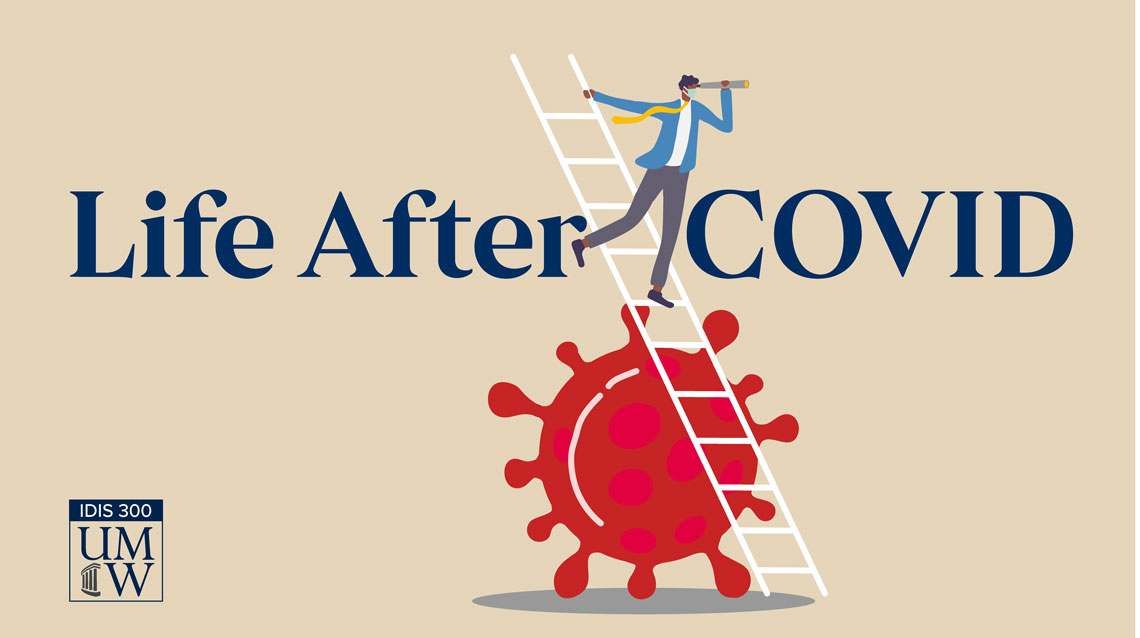
As the country continues to move out of the COVID pandemic, it is time to reflect on what we have learned as a society. Many have suffered, but after the struggle comes a period of growth and development. What issues were exposed? What did we learn? What needs to change?
Life After COVID is a five-week online summer course starting June 1, 2021, that is open to UMW students, faculty, staff, alumni, and the broader community. The course, free to all, will look critically at the exposed social matters of the last year, providing insights and a forward-looking analysis from a variety of perspectives.
Every Tuesday and Thursday at 4 p.m., faculty from various disciplines will broadcast a 30-minute lecture followed by an interactive Q&A session. Each lecture will take a different look at life after a pandemic. It all takes place remotely, delivered to your phone, tablet, or computer via Zoom or YouTube. All you need is internet access.
UMW Students
Current and incoming UMW students who wish to take the course for credit should register through the link above (not via Banner) and check the appropriate box as a for-credit student. Enrolled students will then be admitted into the Canvas course, which contains additional details on the material and delivery. The course is pass/fail only, and students who pass will be awarded 2 credits of IDIS 300 on their fall 2021 UMW transcript at no additional cost. Students who are not planning to enroll in the fall 2021 term or who withdraw from the fall 2021 term after enrollment will not receive credit for this course.
In addition to the lectures from 4 to 5 p.m., for-credit students will complete the following:
- weekly readings
- small-group discussions after each lecture from 5 to 5:30 p.m.
- short weekly quizzes on the presentations for that week
- and a 3- to 5-page reflective paper at the end of the semester.
Registration
Registration will be live until Friday, May 28. After that, enrollment is no longer open to for-credit UMW students. However, anybody else interested in joining the class can contact Dean Keith Mellinger to be added to the weekly distribution list.
Facilitators
Life After COVID is facilitated each week by:
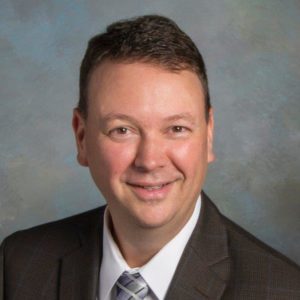
Dr. Keith Mellinger
Professor of Mathematics and Dean of the College of Arts and Sciences
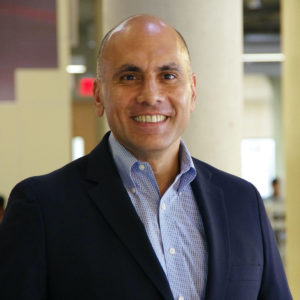
Dr. Anand Rao
Professor of Communication and Chair of the Department of Communication and Digital Studies
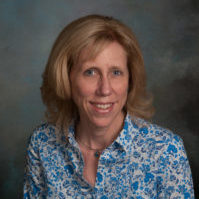
Dr. Betsy Lewis
Professor of Spanish and Assistant Dean of the College of Arts and Sciences
Course Schedule

The Pandemic’s Effect on Business
June 1, 2021, 4:00 pm
We’ll look at how COVID-19 has affected every aspect of our economy, including education, real estate, sports, entertainment, retail, and tourism. Catastrophic events in the past have accelerated underlying marketing trends. What long-term role will COVID play in shaping our future?


Language Rights In the Wake of COVID-19
June 3, 2021, 4:00 pm
COVID-19 has affected every aspect of our lives, including how we use language. Never before had a word (an acronym indeed!) been coined in so many languages in such a short time. While we witnessed a huge effort in effectively communicating information in different languages, the pandemic also showed us how linguistic minorities are systematically excluded from access to information. We’ve learned that we are all more connected than we thought, and that we need to be aware of how linguistically diverse we are so that we are better prepared to face a similar situation in the future.

How Equal Are Women and Men? U.S. Working Mothers’ Vulnerability in a Pandemic
June 8, 2021, 4:00 pm
We’ll explore the disruption to women’s labor force participation and career advancement resulting from the pandemic. With schools across the country moving to online or hybrid instruction, the fact that mothers are still the primary caregivers (even when tasks are shared) has become painfully clear. Families have faced a dilemma over the past year: how to keep jobs while suddenly and simultaneously being fully in charge of childcare and educational responsibilities. The lasting economic impact to the most vulnerable workers will derail careers and livelihoods for years to come.

The University After COVID
June 10, 2021, 4:00 pm
As with every facet of our lives, higher education has been affected by the pandemic, and universities have had to adapt and adjust. We’ll explore some of the longer-term impacts of the pandemic on higher education and discuss which changes may continue afterward.

What Happened Next? Art and Architecture in Florence After the Black Death
June 15, 2021, 4:00 pm
The Black Death, still by far the deadliest pandemic, ravaged Europe in the mid-14th century. By some estimates, two-thirds of the population of Florence died in one year. Writers such as Giovanni Boccaccio tell us what life was like for Florentines during the terrible years of the plague. But what happened afterward, in particular when the number of cases and deaths declined? How was the economy affected? And in what ways did that impact artistic and building projects? We’ll look at art and architecture from the late 14th and early 15th centuries to see what we can learn from Florence’s example.

COVID-19, Cash Transfer Programs, and Inequality
June 17, 2021, 4:00 pm
As countries turn to cash transfer programs to provide quick economic relief to households affected by COVID-19, we will explore some of the key promises and challenges of cash transfers via direct deposits to bank accounts or mobile money transfers. In particular, how effective are cash transfer programs at addressing issues of inequality?


The Federal Government Struggles to Respond to COVID
June 22, 2021, 4:00 pm
The federal government’s responses to COVID-19 are tales of two presidencies (Trump’s and Biden’s) and two Congresses (the 116th and 117th) struggling to meet the challenges posed by this country’s biggest healthcare and economic crises in decades.

From History: How Americans Have Responded to Disasters
June 24, 2021, 4:00 pm
Americans have had to deal with a variety of natural disasters throughout their history – hurricanes, earthquakes, fires, disease, and more. Their responses have reflected their views of God, government, nature, and science.

The Science of COVID: What’s Next?
June 29, 2021, 4:00 pm
The pandemic has had a profound impact on biomedical research, medicine, and public health. Scientific and technological knowledge and resources have been leveraged globally to perform COVID-19 research at warp speed. Many drugs to limit the virus have been approved, and the mRNA vaccines represent a huge victory in the field of vaccine design. Disease diagnosis and treatment are much more manageable in several parts of the globe. Pandemic-related research could guide our response to future crises, offering strategies to balance multiple novel approaches and provide high-quality, time-efficient, cost-effective research and treatment.

COVID and the Future of Communication
July 1, 2021, 4:00 pm
Healthy relationships have always relied on effective communication, and during the pandemic this was more true than ever. Digital communication tools like video messaging and social media were crucial to staying in touch, but the rapid switch affected how we have communicated over the past year. We will look at research about how we communicated during the pandemic, and we’ll forecast how continued use of digital tools, and the continued effects of the pandemic, will shape how we communicate for years to come.