UMW Community Helps Honor Pioneering Musician During Native American Heritage Month
A request for an unfamiliar song. An improvised riff. A mic randomly placed in front of an amp.
A series of impromptu events at a 1950s sock hop in Fredericksburg led to the creation of a signature sound. With the resulting hit single, Rumble, Native American guitarist and songwriter Link Wray became known as the “Godfather of the Power Chord” and earned a place in the Rock and Roll Hall of Fame.
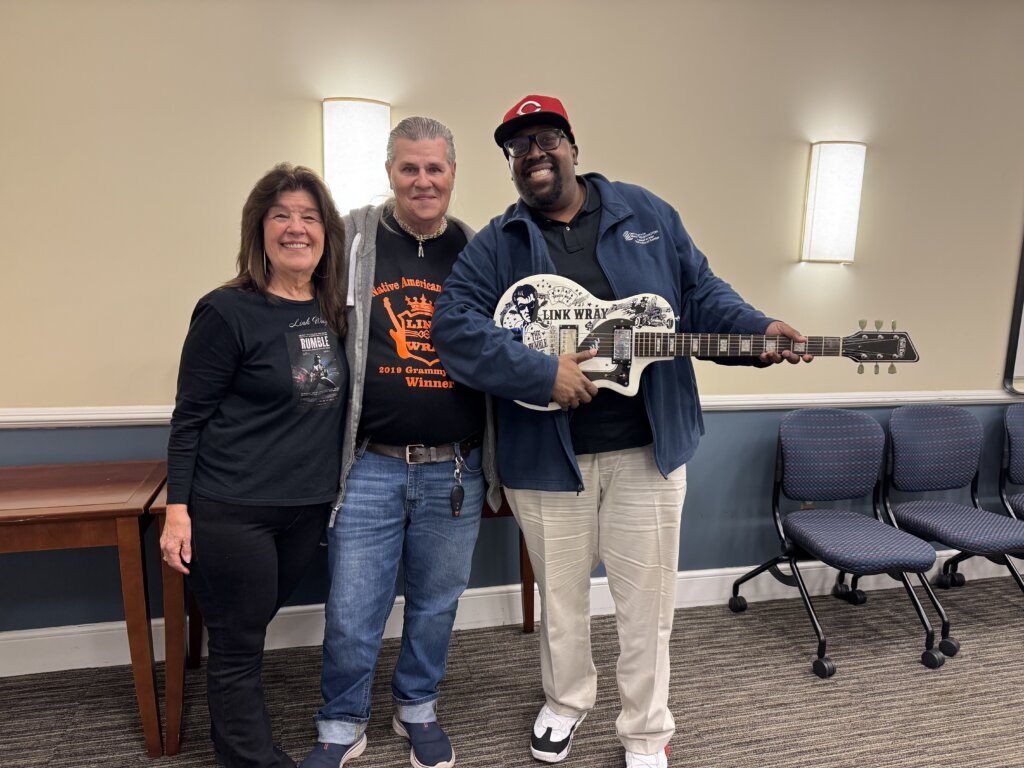
If the groundbreaking performance was a lucky coincidence, a request for University of Mary Washington James Farmer Multicultural Center Assistant Director Chris Williams to help memorialize it was not.
“Learning that something so significant musically happened in my hometown, I wanted to be involved with trying to get a highway marker for the Wray family,” said Williams, who had already led similar efforts. “I really wanted to make this happen in honor and memory of a legendary musician.”
Now, during Native American Heritage Month, Williams’ work – along with contributions from additional UMW community members and supporters – will take center stage at a weekend unveiling ceremony. The event is scheduled for Saturday, Nov. 21, at 1 p.m., in the James Monroe High School auditorium, just minutes from where Wray’s iconic performance took place. The marker will be revealed at the corner of Fall Hill Avenue and Emancipation Highway.
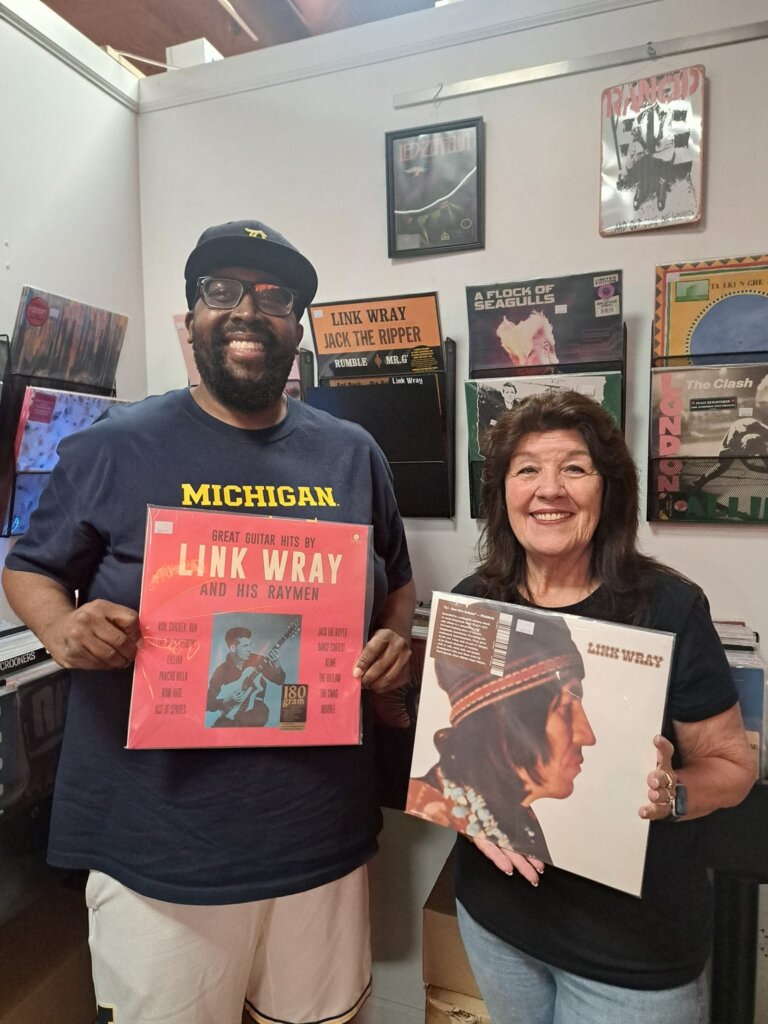
Williams previously led the charge to commemorate Fredericksburg-area history-makers, including facilitating a highway marker on Princess Anne Street tracking the first stop of the 1961 Freedom Rides. He joined the city’s Victoria Matthews to spearhead the creation of the Fredericksburg Civil Rights Trail, “Freedom, A Work in Progress,” which includes several sites on the Mary Washington campus and is part of the U.S. Civil Rights Trail.
So, when Williams, a journalist and cultural historian, was approached at UMW’s 2024 Multicultural Fair about joining the effort to honor Link Wray, he knew he could help. Wray had used a pencil to punch holes in an amplifier speaker to reproduce in a Washington, D.C., recording studio the spontaneous “rumbling” sound he’d stumbled across in Fredericksburg. But Williams wasn’t aware of his work; at least he hadn’t thought so.
“As soon as I heard it, I said, ‘I know this song,’” Williams said of Wray’s Rumble, the Cadence Records release that marked the invention of intentional guitar distortion and paved the way for the use of the power chord in genres like hard rock and heavy metal. “I’d heard it before in movies and thought it was amazing.”
Williams joined Wray’s eldest daughter, Beth Wray Webb, and her friend, historian and longtime area educator Mayo Carter, who’d begun work on a Virginia Department of Historic Resources (VDHR) historic marker proposal in 2019. The initiative had been thrown off course by COVID and other roadblocks, so Williams tapped his connections to pull the process back on track.
He joined forces with UMW Historic Preservation Professor Christine Henry, and the pair called on Department of Music Professor and Chair Brooks Kuykendall to bring clarity to the power-chord concept. “The distortion effects that Wray produced that night changed what was possible for all guitarists after him,” Kuykendall said.
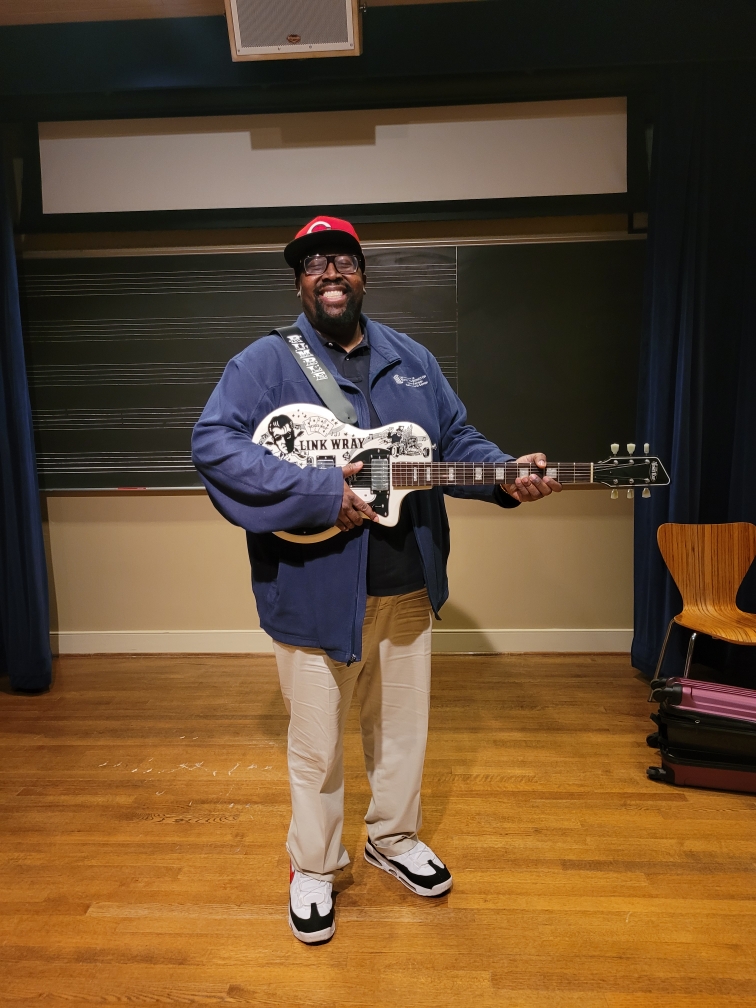
A committee including Webb and members of various tribes began meeting with one goal in mind. “I told her, ‘We’re going to get your father that marker,’” Williams said.
They gathered articles, video clips and oral histories, along with firsthand accounts from Link Wray himself. They conducted interviews with the late Patawomeck Indian Chief John Lightner, who passed away in September, and former Fredericksburg City Councilman Billy Withers, both of whom were present at that long-ago sock hop.
The project proved more challenging than some, said Henry, who directs Mary Washington’s Center for Historic Preservation. “The written record is not as clear-cut,” she said. “There are several possible dates and the oral histories differ.” With her guidance, the group persevered, submitting the materials to VDHR, which approved the marker in June.
Along the way, they got to know the family, including Webb and Wray’s eldest son, Link Wray III, who’d led a similar effort in Maryland resulting in a commemorative mural in Mount Rainier. The family and an array of speakers, including Fredericksburg Mayor Kerry Devine, are slated to be at Saturday’s marker unveiling. Wray’s grandson, Christopher, will play his grandfather’s songs, and members of UMW’s Native American Student Association also will be on hand to lend their support.
Born in North Carolina, Wray – Fred Lincoln Wray Jr. – identified as a member of the Shawnee Tribe, an affiliation his family was forced to hide for fear of Jim Crow-era discrimination. As a young boy, Wray began learning to play guitar from blues legend Hambone Willie Newbern and went on to record more than 40 singles, largely in Washington, D.C., Maryland and Virginia.
“He was truly a DMV artist,” Williams said. “This work is about lifting his legacy and what he contributed to the rock and roll canon.”For more information, visit the Virginia Department of Historic Resources press release: “State Historical Marker to be Dedicate in Fredericksburg for Tune That Influenced Rock & Roll.”
Leave a Reply