Permaculture Design Certificate
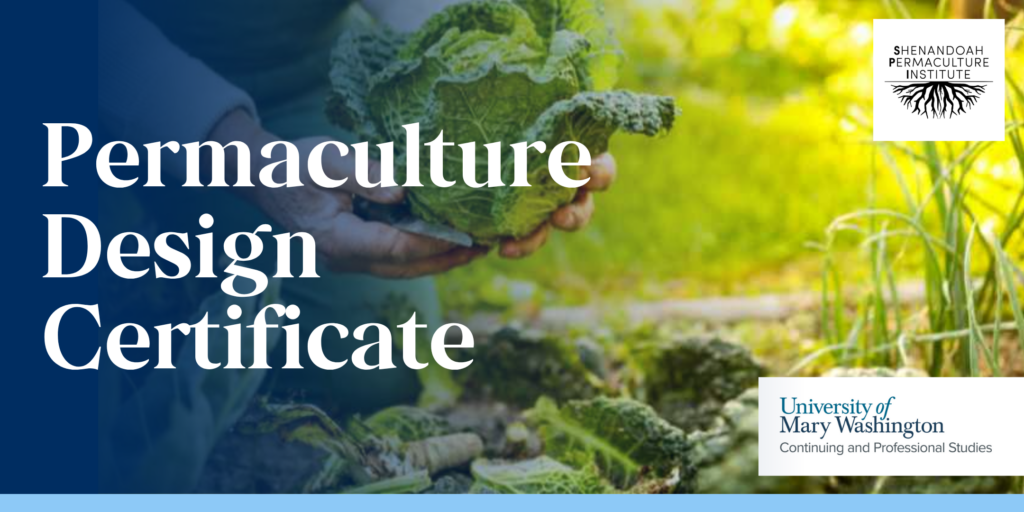
UMW’s Continuing and Professional Studies Department has partnered with Shenandoah Permaculture Institute (SPI) to bring the Permaculture Design Certificate (PDC) training to the Fredericksburg region.
About the Permaculture Design Certificate program
The Permaculture Design Certificate program is an ethically-based, hands-on training that empowers participants to create sustainable human communities. Offered in partnership with the Shenandoah Permaculture Institute, this program explores permaculture principles rooted in agriculture while integrating elements of regional planning, ecology, architecture, and international development.
Through 72 hours of workshops held over four weekends, participants will engage in field trips, collaborative design projects, and practical activities that focus on ethics, design, and sustainability. Modules cover key topics such as regenerative agriculture, water conservation, soil management, and applied permaculture.
Who Should Attend: This course is open to anyone interested in developing a productive, efficient and ecologically sustainable landscape, including backyard gardens, farms, homesteads and communities. Designed for teachers, sustainability professionals, landscape designers, farmers, and community members, this program equips students with real-world permaculture credentials to transform gardens, farms, neighborhoods, and cities into thriving, sustainable ecosystems.
Program Completion Requirements: Attendance at all courses is required. SPI has a strict attendance policy for all PDCs. There will be a final design project assigned in small groups that applies all of the course concepts.
Event Details
- Location: University of Mary Washington, Fredericksburg, VA
- Dates: 4 multi-day sessions on September 18-20, October 3-4, October 24-25, and November 7-8
- Time: 9am – 6pm
- Cost: $1375 per person. Discount codes for early registration with $200 off before July 1 and 10% off for veterans. Registration closes 1 week before the event.
- Group rates: Available for couples.
Program Modules
-
Permaculture Design Process
Design is at the core of the science of permaculture. Learn the full permaculture design process including ethics and principles, patterns in nature, mapping and drawing techniques, and presentation skills. The goal is for you to learn how to create effective designs for your own home, farm and community systems.
-
Regenerative Agriculture
Regenerative agriculture produces abundant nutritious food while increasing the health of the ecosystem. It encompasses innovative techniques such as Food Forests, Perennial Plant Production, Integrated Livestock Systems, Rotational Grazing, Organic Gardening and Mushroom Cultivation. We will learn how to apply these techniques in our homes and farms and visit local sites to see them in action.
-
Social Permaculture
Learn concepts for designing the social landscape or “the human sector.” We will explore techniques for community building, financial permaculture and urban permaculture design.
-
Water Conservation & Management
Water management is a key element of the sustainable farm and homestead. We will learn how to look at water holistically and practice key techniques such as earthworks, swales, ponds, water catchment and keyline design.
-
Soil Management
Permaculture focuses on natural and organic management of soil resources. We will cover soil science with a focus on the soil food web, and learn soil-building techniques such as composting, cover cropping, low-till farming and mycoremediation.
-
The Built Environment
Learn how to integrate the built environment into your permaculture system including greenhouse placement and design, passive solar house design, renewable energy systems and sustainable building techniques such as cob, straw bale and cordwood.
-
Health
Permaculture takes a natural and holistic approach to health that includes herbal medicine and nutrition. Learn how to identify and use wild medicinal plants, how to design and cultivate a medicinal herb garden, and how to craft your own fermented foods and beverages at home.
-
Applied Permaculture
Permaculture design should be practical, tangible and accessible. To bring this idea home we will take field trips to working permaculture sites throughout central Virginia and we will also learn about successful permaculture projects around the world that have inspired us, with a focus on profitable permaculture farm businesses.
Contact Us
For more information or to register for an event, please contact Continuing and Professional Studies at (540) 286-8097 or email us at continuingstudies@umw.edu. Connect with us on social.
Facebook LinkedIn